

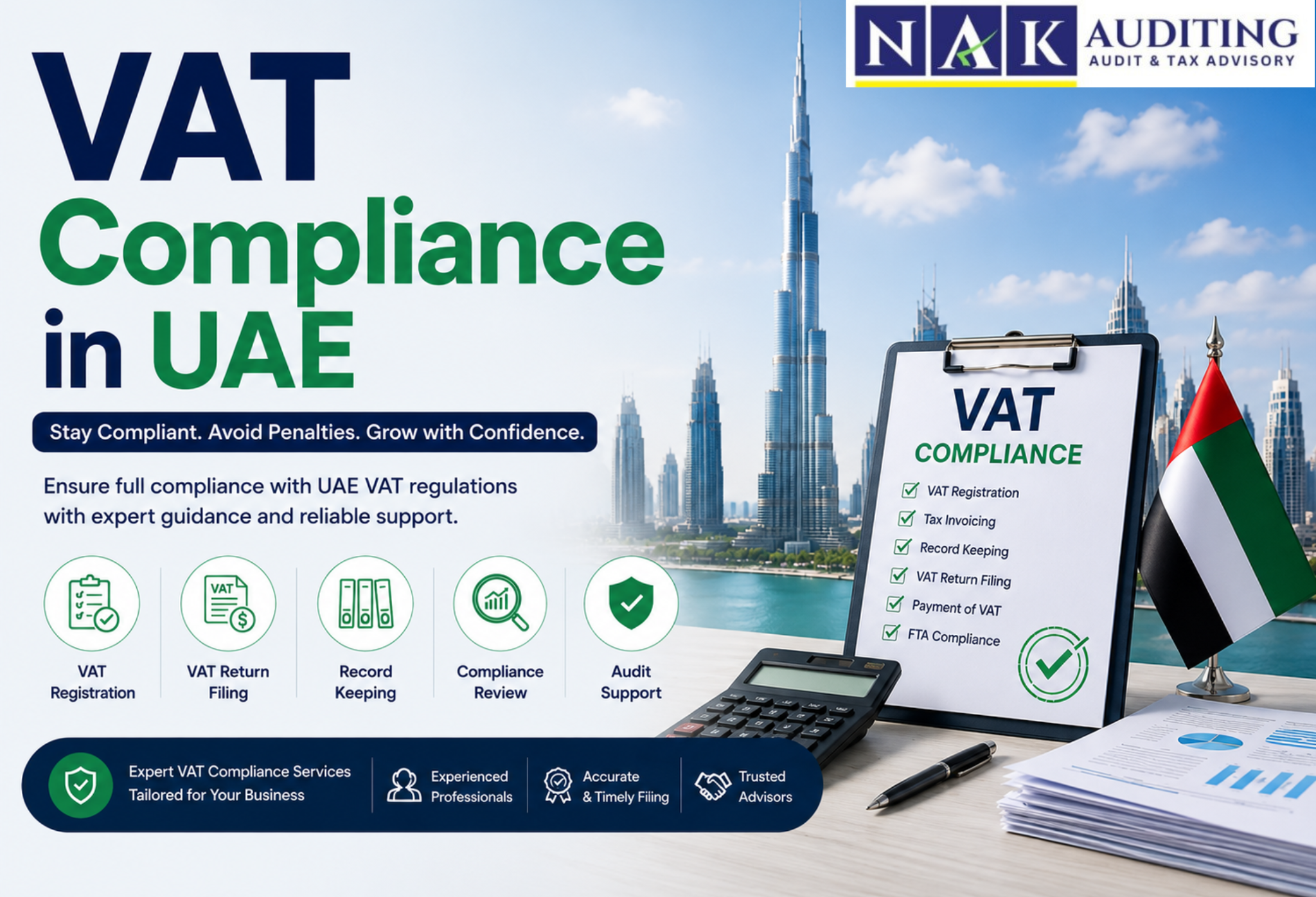
VAT compliance in UAE is one of the most important responsibilities for businesses operating in the country. Since the introduction of Value Added Tax (VAT) in 2018, companies have been required to maintain proper financial records, file VAT returns on time, and comply with the regulations established by the Federal Tax Authority (FTA).
Whether you own a small startup, a trading company, or a multinational corporation, understanding VAT compliance in UAE helps you avoid penalties, maintain business credibility, and ensure smooth operations.
In this guide, you’ll learn everything about VAT compliance, including registration, recordkeeping, filing VAT returns, common mistakes, penalties, and best practices for staying compliant.
What is VAT?
Value Added Tax (VAT) is an indirect tax imposed on the consumption of goods and services. Businesses collect VAT from customers and remit it to the Federal Tax Authority (FTA).
In the UAE:
- Standard VAT rate: 5%
- Certain supplies are zero-rated
- Some supplies are VAT exempt
Businesses registered for VAT must charge VAT on taxable supplies while also claiming eligible input VAT on business expenses.
What is VAT compliance in UAE?
VAT compliance in UAE refers to following all VAT-related rules established by the Federal Tax Authority. It includes:
- VAT registration
- Issuing tax invoices
- Maintaining accounting records
- Filing VAT returns
- Paying VAT on time
- Claiming eligible input tax
- Keeping records for the required period
- Responding to FTA audits
Proper compliance ensures your business remains legally compliant while minimizing tax risks.
Who Needs VAT Registration?
Businesses must register for VAT if their taxable supplies exceed the mandatory registration threshold.
There are two types of registration:
Mandatory Registration
Businesses whose taxable turnover exceeds the mandatory threshold must register for VAT.
Voluntary Registration
Businesses that meet the voluntary threshold may choose to register to recover input VAT and improve credibility.
Failure to register when required can result in significant administrative penalties.
Importance of VAT Compliance in UAE
Maintaining VAT compliance in UAE offers several benefits.
Avoid Penalties
Late filing, incorrect returns, or non-payment can lead to financial penalties imposed by the FTA.
Improve Business Reputation
A compliant business gains greater trust from customers, suppliers, investors, and financial institutions.
Better Financial Management
Accurate VAT accounting improves cash flow management and financial reporting.
Smooth Business Operations
Proper VAT compliance prevents legal complications during audits and inspections.
Business Growth
Businesses with proper tax systems are better prepared for expansion and government tenders.
Key Requirements for VAT Compliance
1. VAT Registration
Businesses meeting the required threshold must complete VAT registration with the Federal Tax Authority.
Registration includes:
- Trade License
- Emirates ID/Passport
- Financial information
- Business activities
- Bank account details
2. Proper Tax Invoices
VAT-registered businesses must issue tax invoices containing:
- TRN (Tax Registration Number)
- Invoice number
- Date
- Customer details
- Description of goods/services
- VAT amount
- Total payable amount
Incorrect invoices may result in compliance issues.
3. Maintain Accounting Records
Businesses must maintain complete accounting records including:
- Sales invoices
- Purchase invoices
- Credit notes
- Debit notes
- Import documents
- Bank statements
- Expense records
These records help during VAT return preparation and FTA audits.
4. File VAT Returns
VAT returns must be submitted according to the assigned tax period.
The VAT return includes:
- Taxable sales
- Zero-rated supplies
- Exempt supplies
- Imports
- Output VAT
- Input VAT
- Net VAT payable
Timely filing is an essential part of VAT compliance in UAE.
5. VAT Payment
Businesses must pay any VAT due before the filing deadline.
Late payments attract penalties and additional charges.
6. Record Retention
Businesses should retain VAT-related records for the period required under UAE tax regulations.
Electronic record keeping is also acceptable if maintained properly.
Common VAT Compliance Mistakes
Many businesses unintentionally violate VAT regulations.
Common mistakes include:
- Late VAT registration
- Missing filing deadlines
- Incorrect VAT calculations
- Claiming ineligible input VAT
- Poor bookkeeping
- Missing tax invoices
- Incorrect TRN details
- Ignoring FTA notices
- Filing inaccurate VAT returns
Avoiding these mistakes significantly improves VAT compliance in UAE.
VAT Penalties in UAE
The Federal Tax Authority may impose penalties for:
- Failure to register
- Late VAT return filing
- Late VAT payment
- Incorrect tax returns
- Failure to maintain records
- Incorrect tax invoices
- Failure to cooperate during audits
The exact penalty depends on the type and severity of the violation.
How Businesses Can Improve VAT Compliance
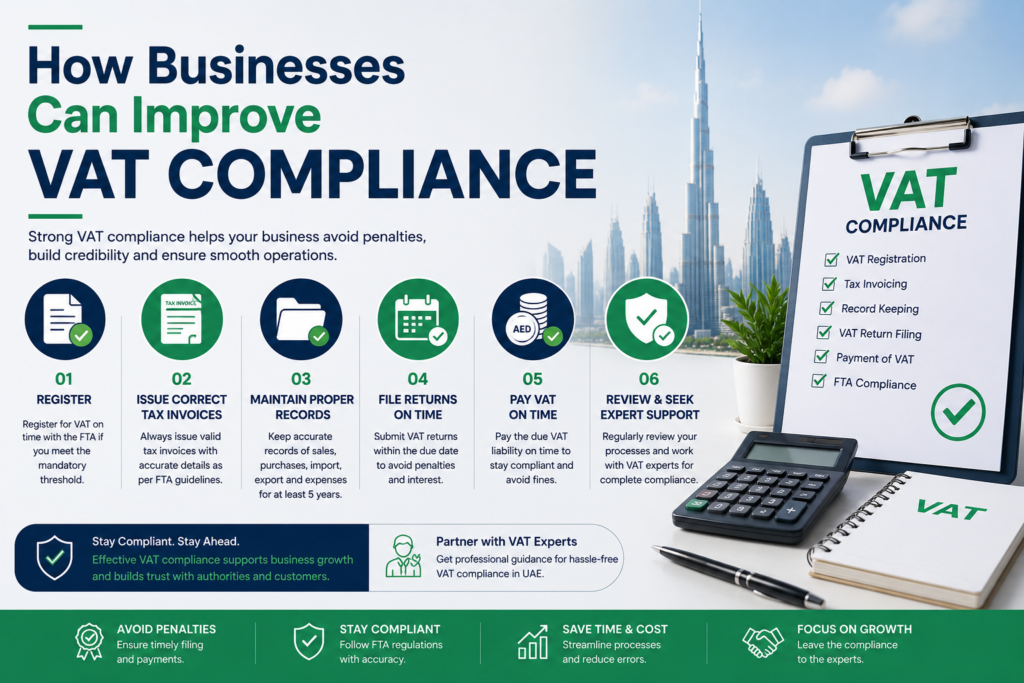
Maintain Accurate Accounting
Good bookkeeping forms the foundation of VAT compliance.
Use accounting software that records every transaction accurately.
Train Employees
Finance staff should understand VAT rules and updates issued by the FTA.
Regular training reduces errors.
Conduct Internal Reviews
Periodic VAT reviews help identify errors before filing returns.
Internal audits reduce compliance risks.
Reconcile Accounts
Compare:
- Sales
- Purchases
- VAT collected
- VAT paid
- Bank statements
Regular reconciliation prevents reporting mistakes.
Keep Supporting Documents
Always maintain:
- Purchase invoices
- Sales invoices
- Import documents
- Contracts
- Credit notes
These documents support VAT claims.
VAT Audit by the Federal Tax Authority
The FTA may conduct VAT audits to verify compliance.
During an audit, businesses may be asked to provide:
- Financial statements
- VAT returns
- Purchase records
- Sales records
- Import documents
- Accounting software reports
- Tax invoices
Businesses with organized records usually complete audits smoothly.
Best Practices for VAT Compliance
To maintain excellent VAT compliance in UAE, businesses should:
- File VAT returns before deadlines.
- Reconcile accounts every month.
- Verify supplier VAT numbers.
- Review VAT treatment of transactions.
- Keep accurate accounting records.
- Monitor changes in VAT legislation.
- Conduct regular VAT health checks.
- Seek professional tax advice when needed.
These practices reduce compliance risks and improve financial efficiency.
Role of Professional VAT Consultants
VAT regulations can become complex, especially for growing businesses.
Professional VAT consultants help with:
- VAT registration
- VAT return filing
- VAT health checks
- Tax planning
- VAT advisory
- VAT audit support
- Record verification
- FTA correspondence
Professional assistance minimizes risks while ensuring full compliance.
Benefits of Outsourcing VAT Compliance
Many UAE businesses outsource VAT management because it offers:
- Reduced compliance risk
- Expert guidance
- Accurate VAT filing
- Time savings
- Better documentation
- Lower chances of penalties
- Updated knowledge of tax regulations
This allows business owners to focus on growth rather than tax administration.
Future of VAT Compliance in UAE
As the UAE continues to strengthen its tax framework, businesses should expect increased digitalization, enhanced reporting requirements, and greater regulatory oversight. Staying updated with FTA announcements and implementing strong internal controls will help businesses adapt to future changes with confidence.
Investing in technology, professional expertise, and proactive compliance strategies ensures long-term success and minimizes tax-related risks.
Conclusion
Maintaining VAT compliance in UAE is essential for every business operating in the country. From VAT registration and accurate bookkeeping to timely return filing and proper record maintenance, every step plays a vital role in ensuring compliance with Federal Tax Authority regulations.
Ignoring VAT obligations can lead to unnecessary penalties, financial losses, and operational disruptions. By adopting best practices and seeking expert guidance, businesses can stay compliant while focusing on sustainable growth.
NAK Auditing is your trusted partner for comprehensive VAT compliance services in the UAE. Our experienced professionals provide expert assistance with VAT registration, return filing, VAT advisory, bookkeeping, compliance reviews, and FTA audit support. Whether you are a startup or an established enterprise, NAK Auditing helps you navigate VAT regulations with confidence, ensuring your business remains fully compliant and financially secure.
FAQS
VAT compliance in UAE refers to following all Federal Tax Authority regulations related to VAT registration, record keeping, tax invoicing, VAT return filing, and tax payments.
Businesses exceeding the VAT threshold must register with the FTA.
Most businesses file quarterly, while some file monthly.
Sales and purchase invoices, tax invoices, bank statements, and VAT records.
Businesses may face FTA penalties, interest, and audits.
Yes, eligible VAT-registered businesses can recover input VAT.
A VAT consultant helps ensure accurate compliance, timely filing, and reduces penalty risks.
Social Profiles