


The introduction of corporate tax in the United Arab Emirates has changed the way businesses manage their financial and tax responsibilities. Companies operating in the UAE now need to understand their corporate tax obligations, maintain proper accounting records, calculate taxable income correctly, and submit their returns within the prescribed deadlines.
Corporate tax return filing in dubai is therefore an important compliance responsibility for businesses that fall within the scope of UAE corporate tax. Proper preparation can help businesses avoid errors, manage their tax liabilities efficiently, and reduce the risk of penalties.
Whether you operate a mainland company, free zone business, branch, or another taxable entity, understanding the filing process is essential for maintaining compliance with the Federal Tax Authority (FTA).
What Is UAE Corporate Tax?
UAE Corporate Tax is a federal tax imposed on the taxable income of businesses and other entities within the scope of the UAE Corporate Tax Law. The standard corporate tax rate is 9% on taxable income exceeding AED 375,000, while taxable income up to AED 375,000 is subject to a 0% rate.
Certain entities and types of income may receive specific exemptions or treatment under the legislation. Qualifying Free Zone Persons may also benefit from a 0% corporate tax rate on qualifying income, subject to meeting the applicable requirements.
Businesses should not assume that being located in a free zone automatically means that all income is taxed at 0%. The applicable rules and conditions need to be reviewed carefully.
Why Corporate Tax Return Filing Is Important
Corporate tax return filing in Dubai is more than simply submitting a form to the FTA. Businesses must examine their financial data, calculate their taxable revenue, make any necessary modifications, and make sure the data they provide to the FTA is correct
Timely filing helps businesses
- Meet their legal tax obligations
- Avoid unnecessary administrative penalties
- Maintain accurate financial records
- Understand their Corporate Tax liability
- Support better financial planning
- Reduce the risk of incorrect tax reporting
- Maintain proper documentation for future reference
Businesses should establish a tax compliance process rather than waiting until the filing deadline.
Who Needs to File a Corporate Tax Return in the Dubai?
Generally, taxable persons subject to UAE Corporate Tax are required to register for corporate tax and file a corporate tax return with the FTA.
This can include UAE-incorporated companies, certain branches, and other juridical persons, as well as certain foreign entities that conduct business or have a taxable presence in the UAE, depending on their circumstances.
The corporate tax treatment of individuals carrying on business activities, free zone companies, exempt persons, government entities, partnerships, and other structures can differ.
Because the rules depend on the nature of the entity and its activities, businesses should assess their specific position before determining their filing obligations.
What Is the Corporate Tax Return Filing Deadline?
The corporate tax return and payment of corporate tax generally need to be completed within nine months from the end of the relevant tax period, unless a different deadline applies under the applicable rules.
For example, if a company’s tax period ends on 31 December 2025, the standard nine-month period would generally lead to a filing deadline of 30 September 2026.
Businesses should confirm their individual tax period and applicable deadline rather than relying only on general examples.
Missing a deadline can result in administrative consequences, making advance preparation particularly important.
Steps Involved in Corporate Tax Return Filing
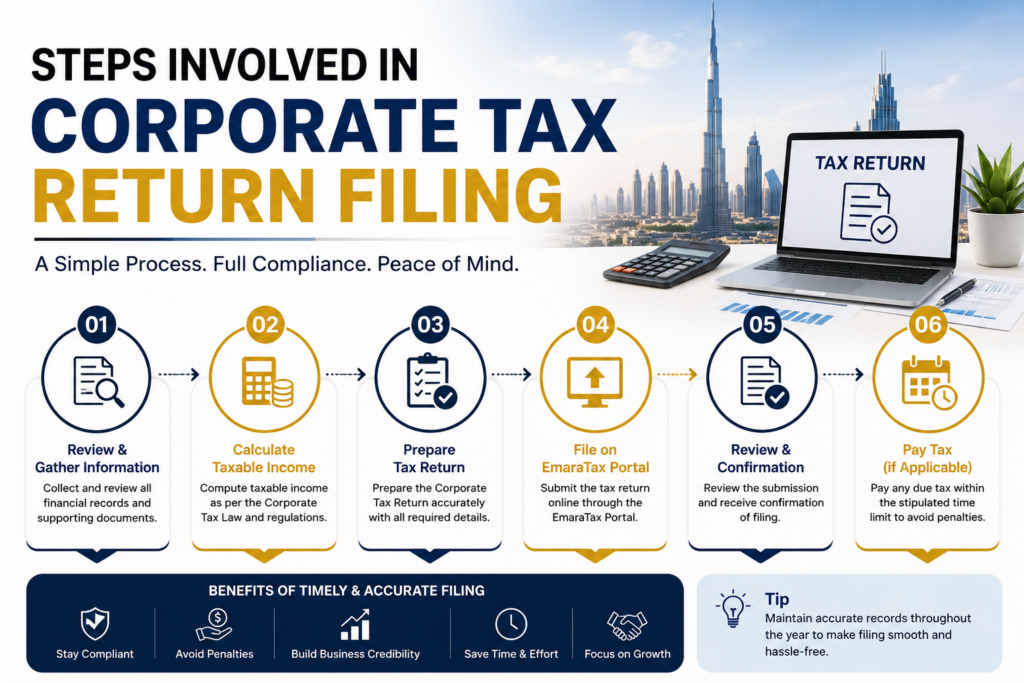
A structured approach makes corporate tax return filing in UAE easier and more reliable. The following steps can help businesses organize their compliance process.
1. Confirm Corporate Tax Registration
The first step is to confirm that the business is correctly registered for corporate tax with the FTA and has the appropriate corporate tax registration details.
Businesses should also ensure that their registration information remains accurate and up to date.
2. Determine the Tax Period
The business needs to identify the relevant tax period for which the corporate tax return will be prepared.
The tax period is generally based on the financial year of the business. Maintaining a clearly defined accounting period helps ensure that financial information is correctly matched to the relevant corporate tax period.
3. Prepare Accurate Financial Statements
Reliable accounting records form the foundation of corporate tax compliance.
Businesses should prepare appropriate financial statements and ensure that revenue, expenses, assets, liabilities, and other transactions are properly recorded.
Bank reconciliations, accounts receivable, accounts payable, payroll records, and supporting invoices should also be reviewed.
4. Calculate Taxable Income
Corporate Tax is not necessarily calculated simply by applying 9% to accounting profit.
The business must determine taxable income in accordance with the UAE corporate tax rules. This may require adjustments to accounting profit for items that receive different tax treatment.
Examples may include certain exempt income, non-deductible expenses, reliefs, and other adjustments prescribed under the legislation.
5. Review Free Zone Tax Treatment
Free zone businesses should carefully evaluate whether they qualify for the applicable 0% Corporate Tax treatment on qualifying income.
Maintaining the required conditions and records is important. A free zone company should not automatically assume that all of its income qualifies for the 0% rate.
6. Review Supporting Documents
Before submitting the return, businesses should review relevant supporting documents.
These may include:
- Sales invoices
- Purchase invoices
- Bank statements
- Contracts
- Expense records
- Payroll records
- Fixed asset information
- Financial statements
- Tax registration details
- Related-party transaction information
- Other relevant accounting documentation
Good documentation can support the figures reported in the corporate tax return.
7. Submit the Return Through EmaraTax
Corporate tax registration and return filing are generally handled electronically through the FTA’s EmaraTax platform.
The business or its authorized tax representative should enter the required information, review the return carefully, and submit it within the applicable deadline.
8. Pay the Corporate Tax Liability
If Corporate Tax is payable, the business should ensure that the amount due is paid within the required timeframe.
Filing the return and paying the tax are both important parts of Corporate Tax compliance.
Common Mistakes Businesses Should Avoid
Several mistakes can make corporate tax return filing in Dubai more difficult and may increase compliance risks.
Late Registration or Filing
Businesses should monitor their registration and filing deadlines carefully. Waiting until the last moment can create unnecessary pressure and increase the possibility of mistakes.
Incorrect Taxable Income Calculation
Using accounting profit without considering the relevant corporate tax adjustments can result in an incorrect tax liability.
Poor Record Keeping
Incomplete invoices, missing bank records, or poorly maintained accounting books can make it difficult to support the information included in the return.
Ignoring Free Zone Requirements
Free zone businesses should understand the conditions applicable to qualifying free zone persons rather than assuming that all income automatically receives a 0% tax rate.
Failing to Review Related-Party Transactions
Transactions with related parties and connected persons may require specific consideration under UAE corporate tax and transfer pricing rules.
Mixing Personal and Business Transactions
Businesses should maintain clear separation between business and personal transactions. Proper accounting controls make tax reporting more transparent and reliable.
How Professional Tax Support Can Help
Managing corporate tax internally can be challenging, particularly for businesses without dedicated accounting or tax teams.
Professional support can help businesses review their accounting records, identify relevant tax adjustments, calculate taxable income, prepare corporate tax returns, and meet filing deadlines.
An experienced adviser can also help identify potential compliance gaps before the return is submitted.
This is particularly useful for businesses with complex transactions, multiple activities, related-party dealings, free zone operations, or significant accounting adjustments.
Corporate Tax and Accounting Records
Accurate bookkeeping is closely connected with successful corporate tax compliance. Businesses should maintain accounting records that allow them to clearly understand their financial position and support their tax calculations.
Regular bookkeeping can make the annual tax return process considerably easier because financial information is already organized and reconciled.
Instead of preparing records only when the filing deadline approaches, businesses should maintain their accounts throughout the year.
Preparing for Future Tax Periods
Corporate Tax compliance should be treated as an ongoing business process.
Companies can improve their tax compliance by:
- Maintaining monthly bookkeeping
- Reconciling bank accounts regularly
- Keeping invoices and supporting documents
- Reviewing expenses for tax treatment
- Monitoring related-party transactions
- Tracking Corporate Tax deadlines
- Reviewing free zone eligibility where applicable
- Maintaining proper financial statements
- Seeking professional advice when required
A consistent approach reduces the workload at the end of the tax period and allows management to make better financial decisions.
Conclusion
Understanding corporate tax return filing in Dubai is essential for businesses that want to remain compliant with UAE tax regulations and maintain sound financial management. From corporate tax registration and bookkeeping to taxable income calculations, documentation, return submission, and payment, every stage should be handled carefully.
Businesses should avoid treating corporate tax filing as a last-minute responsibility. Maintaining accurate accounts throughout the year and reviewing tax obligations regularly can help reduce errors and make the filing process smoother.
NAK Auditing provides professional accounting, auditing, VAT, and corporate tax support to businesses in the UAE. From reviewing financial records and assisting with tax calculations to supporting return preparation and compliance, NAK Auditing can help businesses manage their tax responsibilities with greater confidence.
If your business needs assistance with corporate tax return filing in Dubai, professional guidance from NAK Auditing can help you understand your obligations, prepare accurate information, and work towards timely compliance.
FAQS
Corporate tax return filing is the process through which a taxable business reports its relevant financial and tax information to the UAE Federal Tax Authority and declares its corporate tax liability for the applicable tax period.
The standard UAE Corporate Tax rate is 0% on taxable income up to AED 375,000 and 9% on taxable income exceeding AED 375,000, subject to the applicable legislation and conditions.
Generally, a corporate tax return must be submitted within nine months from the end of the relevant tax period, subject to applicable rules and exceptions.
Free Zone companies may still have corporate tax registration and filing obligations. A qualifying Free Zone Person may benefit from a 0% rate on qualifying income if the applicable conditions are satisfied.
A business can manage its own tax compliance, but professional accounting or tax support can be valuable where the business has complex transactions, substantial adjustments, related-party dealings, or uncertainty about the tax rules.
Businesses should maintain accounting records, invoices, contracts, bank statements, financial statements, expense records, and other documents supporting their transactions and Corporate Tax calculations.
Late filing or other compliance failures may result in administrative penalties or other consequences under UAE tax regulations. Businesses should therefore monitor their deadlines carefully and act promptly if a compliance issue arises.
No, corporate tax and VAT are separate UAE tax regimes. Corporate Tax generally applies to taxable income, while VAT is an indirect tax imposed on taxable supplies and imports at the applicable rate.
Social Profiles