

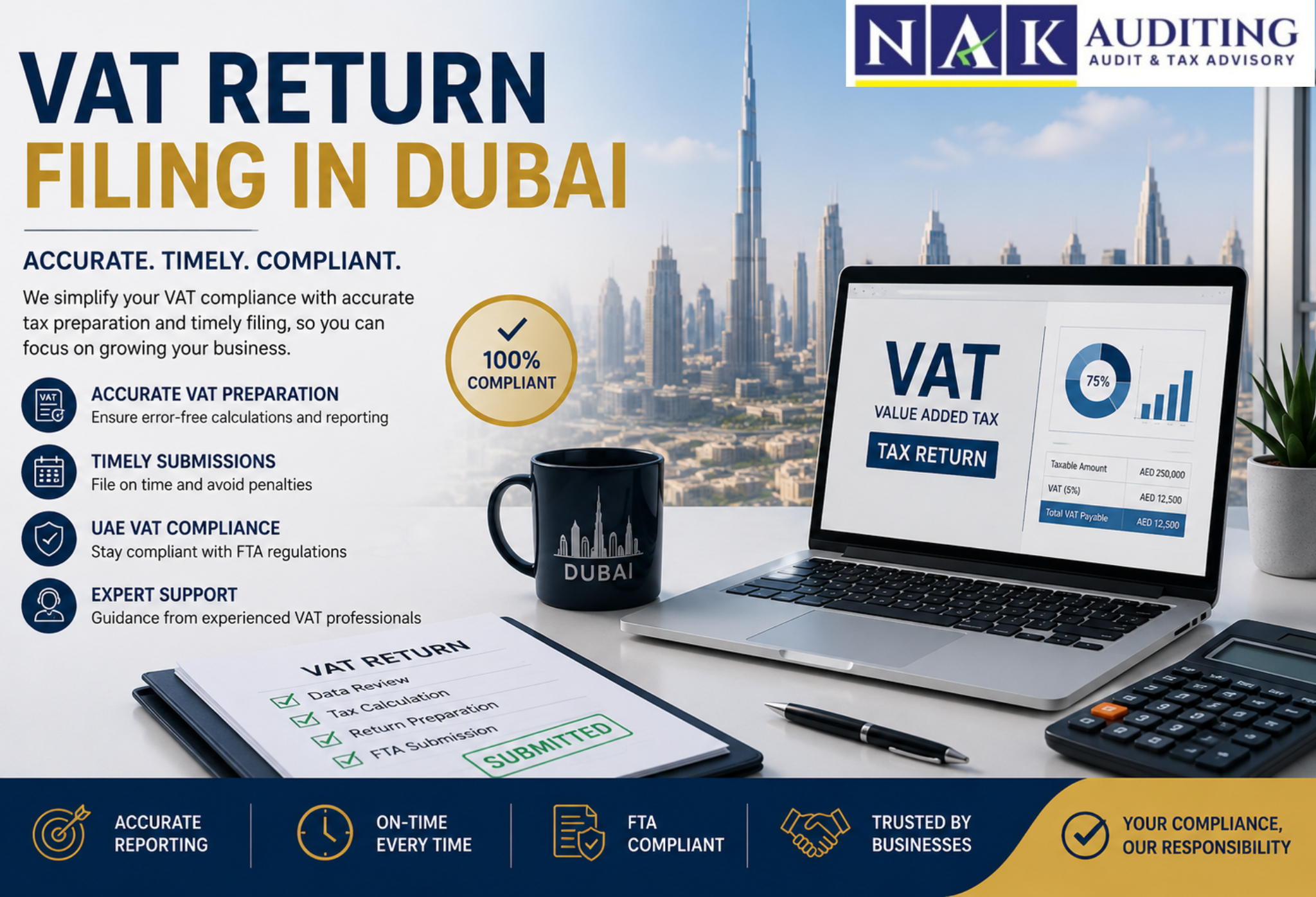
Dubai has established itself as one of the world’s leading business destinations, attracting startups, SMEs, and multinational corporations. While the UAE offers a business-friendly tax environment, companies registered for Value Added Tax (VAT) must comply with the regulations set by the Federal Tax Authority (FTA). One of the most important compliance requirements is VAT return filing in Dubai.
Timely and accurate VAT return filing helps businesses avoid penalties, maintain compliance, and build financial credibility. Whether you operate a trading company, consultancy, retail store, manufacturing business, or e-commerce company, understanding the VAT filing process is essential.
In this comprehensive guide, you’ll learn everything about VAT return filing in Dubai, including its importance, filing process, required documents, deadlines, common mistakes, benefits of professional assistance, and frequently asked questions.
What is VAT Return Filing?
VAT return filing is the process of submitting a report to the Federal Tax Authority (FTA) that summarizes a business’s VAT transactions during a specific tax period.
The VAT return includes:
- Total taxable sales
- Zero-rated supplies
- Exempt supplies
- Purchases and expenses
- Input VAT paid
- Output VAT collected
- VAT payable or refundable
The purpose of filing is to calculate the difference between the VAT collected from customers and the VAT paid on business expenses.
Why is VAT Return Filing Important?
Every VAT-registered business is legally required to submit VAT returns within the deadlines specified by the FTA.
Proper VAT return filing in Dubai offers several benefits:
- Ensures compliance with UAE tax laws
- Avoids late filing penalties
- Maintains accurate financial records
- Improves business transparency
- Builds credibility with investors
- Supports smooth financial audits
- Prevents unnecessary tax disputes
Businesses that fail to submit VAT returns accurately may face substantial fines and additional scrutiny from tax authorities.
Who Must File VAT Returns in Dubai?
Businesses registered under UAE VAT regulations must submit VAT returns if they:
- Exceed the mandatory VAT registration threshold
- Have voluntarily registered for VAT
- Supply taxable goods or services
- Import taxable goods into the UAE
Regardless of the size of the business, once VAT registration is complete, VAT return filing becomes a mandatory compliance obligation.
Documents Required for VAT Return Filing
Before preparing your VAT return, gather all necessary financial records.
These typically include:
- Sales invoices
- Purchase invoices
- Credit notes
- Debit notes
- Import and export documents
- Customs declarations
- Bank statements
- Accounting records
- Expense receipts
- Previous VAT returns (if applicable)
Maintaining organized documentation makes the filing process faster and more accurate.
Step-by-Step Process of VAT Return Filing
1. Record Financial Transactions
Ensure all sales and purchases have been accurately recorded during the tax period.
2. Calculate Output VAT
Output VAT refers to the VAT collected from customers on taxable sales.
3. Calculate Input VAT
Input VAT is the VAT paid on eligible business purchases and expenses.
4. Determine VAT Payable
Subtract Input VAT from Output VAT.
- If Output VAT exceeds Input VAT, the difference must be paid to the FTA.
- If Input VAT exceeds Output VAT, you may be eligible for a VAT refund or adjustment.
5. Complete the VAT return form
Log in to the FTA portal and complete the VAT201 return form.
Enter:
- Taxable sales
- Zero-rated sales
- Exempt supplies
- Imports
- Expenses
- VAT calculations
6. Review the Information
Double-check all figures before submission.
Common errors include:
- Incorrect invoice values
- Duplicate entries
- Missing purchases
- Wrong VAT percentages
7. Submit the Return
Once verified, submit the VAT return electronically through the FTA portal.
8. Pay Outstanding VAT
If VAT is payable, complete payment before the due date to avoid penalties.
VAT Return Filing Deadlines
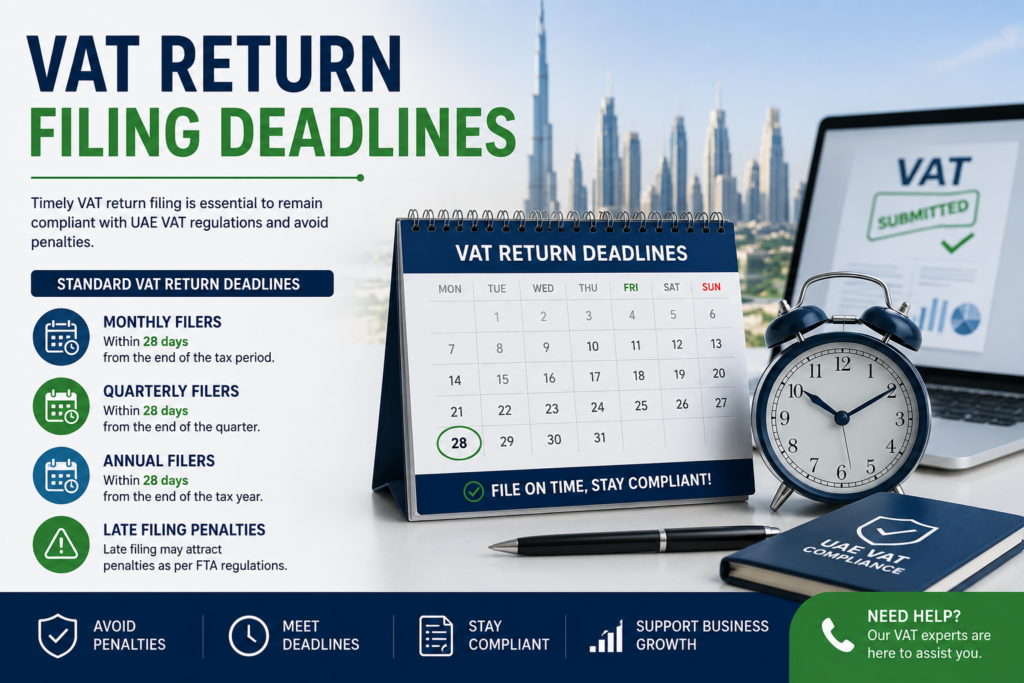
The Federal Tax Authority assigns filing periods to registered businesses.
Most companies file:
- Monthly
- Quarterly
The VAT return must generally be submitted within 28 days after the end of the tax period.
Missing the deadline can result in administrative penalties and interest on unpaid amounts.
Common Mistakes During VAT Return Filing
Many businesses unintentionally make filing errors.
Some common mistakes include:
- Missing filing deadlines
- Incorrect VAT calculations
- Claiming ineligible input VAT
- Missing tax invoices
- Recording duplicate transactions
- Incorrect tax treatment of supplies
- Failure to reconcile accounts
- Poor bookkeeping
Professional accounting support significantly reduces these risks.
Benefits of Professional VAT Return Filing Services
Hiring VAT experts provides numerous advantages.
Improved Accuracy
Experienced professionals verify every transaction before filing.
Time Savings
Business owners can focus on operations while experts handle tax compliance.
Reduced Risk
Professional review minimizes costly mistakes.
Better Record Keeping
Experts maintain organized financial records throughout the year.
Compliance with UAE Laws
Tax professionals stay updated with the latest FTA regulations.
Audit Support
Proper documentation makes tax audits easier and less stressful.
How Good Bookkeeping Supports VAT Filing
Accurate bookkeeping forms the foundation of successful VAT compliance.
When financial records are updated regularly:
- VAT calculations become easier.
- Tax returns are more accurate.
- Financial reports improve.
- Cash flow is easier to monitor.
- Compliance risks decrease.
Businesses that invest in proper bookkeeping often experience smoother VAT return filing in Dubai and fewer compliance issues.
Tips for Smooth VAT Return Filing
To simplify your VAT obligations:
- Keep invoices organized.
- Update accounting records regularly.
- Reconcile bank statements monthly.
- Verify supplier VAT numbers.
- Review VAT calculations before submission.
- Maintain digital copies of tax documents.
- Monitor filing deadlines.
- Work with experienced VAT consultants.
These practices improve accuracy and reduce the likelihood of penalties.
Why Businesses Choose Professional VAT Consultants
Managing VAT internally can become challenging as a business grows.
Professional VAT consultants help businesses:
- Prepare VAT returns
- Verify tax calculations
- Ensure FTA compliance
- Handle VAT registration
- Manage VAT deregistration
- Respond to FTA queries
- Maintain accurate accounting records
Their expertise reduces financial risks while improving operational efficiency.
Conclusion
Timely and accurate VAT return filing in Dubai is essential for every VAT-registered business. It ensures compliance with the Federal Tax Authority, helps avoid penalties, improves financial transparency, and supports better business decision-making. Maintaining accurate bookkeeping, keeping proper tax records, and filing VAT returns on time are crucial steps toward long-term business success in the UAE.
If you’re looking for reliable and professional assistance, NAK Auditing is your trusted partner for VAT return filing, bookkeeping, accounting, corporate tax, and financial compliance services in Dubai. With a team of experienced tax professionals, NAK Auditing helps businesses prepare accurate VAT returns, meet FTA deadlines, minimize compliance risks, and maintain organized financial records. Whether you’re a startup, SME, or large enterprise, NAK Auditing provides tailored solutions that allow you to focus on growing your business while ensuring complete tax compliance and peace of mind.
FAQS
VAT return filing in Dubai is the process of submitting VAT transaction details to the UAE Federal Tax Authority (FTA) for a specific tax period.
All businesses registered for VAT with the FTA must submit VAT returns according to their assigned monthly or quarterly filing schedule
VAT returns must generally be submitted within 28 days after the end of the tax period assigned by the FTA.
Late filing may result in administrative penalties, interest on unpaid VAT, and additional compliance actions by the FTA.
You typically need sales invoices, purchase invoices, credit notes, debit notes, customs documents, bank statements, and accounting records.
Yes, eligible business expenses that meet FTA requirements may qualify for input VAT recovery.
A professional consultant helps ensure accurate VAT calculations, timely submissions, compliance with UAE regulations, and reduced risk of penalties.
Social Profiles