

The UAE has established itself as one of the world’s most attractive destinations for businesses and investors. With the introduction of corporate tax regulations, companies operating in the country must ensure they meet all tax obligations on time. One of the most important requirements is understanding the UAE corporate tax registration deadline and completing registration before the due date.
Many business owners are still learning about corporate tax requirements and registration procedures. Missing the deadline can lead to penalties and compliance issues that may affect business operations. Therefore, it is essential for companies to understand their responsibilities and take timely action.
Understanding Corporate Tax in the UAE
Corporate tax is a tax imposed on the profits earned by businesses. The UAE introduced corporate tax to align with international standards and strengthen its position as a transparent and globally competitive economy.
Under the current tax framework:
- Taxable income up to AED 375,000 is taxed at 0%.
- Taxable income exceeding AED 375,000 is taxed at 9%.
Businesses that fall under the corporate tax regime must register with the Federal Tax Authority (FTA) and comply with all applicable regulations before the UAE corporate tax registration deadline.
Why the UAE Corporate Tax Registration Deadline Matters
The UAE Corporate Tax Registration Deadline is not just an administrative requirement. It is a legal obligation that businesses must fulfill.
Meeting the deadline provides several benefits:
- Compliance with UAE tax laws
- Avoidance of financial penalties
- Better financial transparency
- Improved business credibility
- Smooth tax return filing
Companies that ignore registration requirements may face fines and regulatory complications that can affect their reputation and operations.
Which Businesses Must Register?
The requirement to register for corporate tax applies to various business structures operating in the UAE.
Mainland Companies
Most mainland companies conducting commercial activities must register and comply with corporate tax regulations.
Free Zone Entities
Free zone businesses may enjoy certain tax benefits, but they are generally still required to complete registration and meet compliance obligations.
Foreign Companies
Foreign entities with a taxable presence in the UAE may also need to register.
Branch Offices
Branches of overseas companies operating in the UAE may be subject to corporate tax registration requirements.
Sole Establishments
Some individual business owners may also be required to register depending on their business activities and income levels.
Understanding your obligations before the UAE Corporate Tax Registration Deadline helps prevent compliance issues later.
Consequences of Missing the Registration Deadline
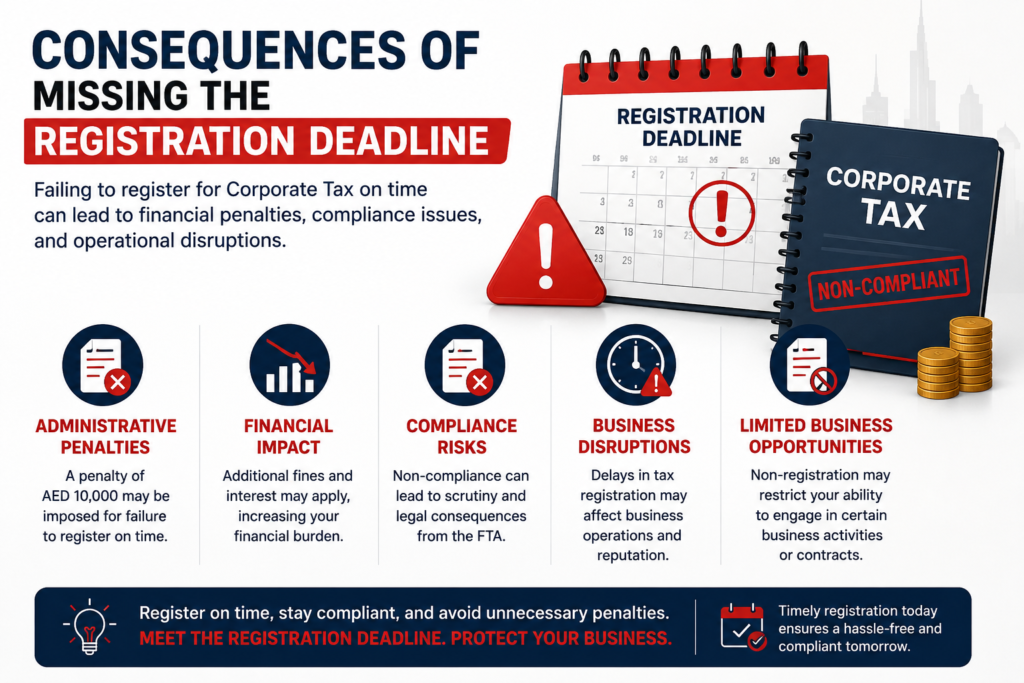
Failing to register on time can create several problems for businesses.
Financial Penalties
The Federal Tax Authority may impose fines on businesses that fail to register within the required timeframe.
Compliance Risks
Late registration may trigger additional reviews and compliance checks.
Business Disruptions
Non-compliance can create administrative challenges that affect daily business operations.
Increased Costs
Businesses may incur additional expenses to correct compliance issues after missing the deadline.
Meeting the UAE Corporate Tax Registration Deadline helps companies avoid these unnecessary risks.
Documents Required for Registration
Before starting the registration process, businesses should gather the required documents.
Commonly required documents include:
- Trade License
- Passport copy of owners or partners
- Emirates ID
- Memorandum of Association
- Contact information
- Company address details
- Authorization letter where applicable
Having complete and accurate documentation can significantly speed up the registration process.
Step-by-Step Registration Process
Create an FTA Account
Businesses must first create an account through the Federal Tax Authority portal.
Select Corporate Tax Registration
After logging in, select the corporate tax registration service.
Enter Company Information
Provide details such as:
- Legal business name
- Trade license information
- Business activities
- Ownership details
- Contact information
Upload Supporting Documents
Submit all required documents in the specified format.
Review and Submit
Double-check all information before submitting the application.
Receive Registration Confirmation
Once approved, the business receives its corporate tax registration number.
Completing these steps before the UAE corporate tax registration deadline ensures compliance and peace of mind.
Common Mistakes Businesses Should Avoid
Many companies make avoidable errors during registration.
Delaying the Process
Waiting until the last minute can increase the risk of missing deadlines.
Incorrect Information
Errors in company details can delay approvals.
Missing Documents
Incomplete applications often require resubmission.
Ignoring Professional Advice
Businesses unfamiliar with tax regulations may overlook important compliance requirements.
Avoiding these mistakes can make registration much smoother.
Benefits of Early Registration
Registering before the deadline offers several advantages.
Better Preparation
Businesses have more time to understand their tax obligations.
Improved Record Keeping
Early registration encourages proper accounting practices.
Reduced Compliance Stress
Completing registration early eliminates last-minute pressure.
Stronger Business Reputation
Compliance demonstrates professionalism and reliability.
Easier Tax Planning
Businesses can plan future financial activities more effectively.
Ongoing Compliance Requirements
Registration is only the beginning of the corporate tax journey.
Businesses must continue to:
- Maintain proper accounting records
- Prepare financial statements
- File tax returns on time
- Retain supporting documents
- Monitor regulatory updates
Compliance is an ongoing process that requires attention throughout the year.
How Professional Advisors Help
Many businesses choose professional consultants to manage their corporate tax obligations.
Professional advisors can assist with:
- Corporate tax registration
- Compliance reviews
- Tax return preparation
- Accounting support
- Record management
- Regulatory guidance
Their expertise helps businesses reduce errors and remain compliant.
Best Practices for Meeting the UAE Corporate Tax Registration Deadline
To ensure successful registration:
- Start the process early
- Maintain organized business records
- Verify all information before submission
- Monitor FTA announcements regularly
- Consult tax professionals when necessary
- Keep documentation updated
These simple practices can significantly reduce compliance risks.
Conclusion
The UAE Corporate Tax Registration Deadline is a critical requirement for businesses operating in the UAE. Registering on time helps companies comply with regulations, avoid penalties, and maintain a strong business reputation. Understanding the registration process and preparing the necessary documentation in advance can make compliance much easier.
For businesses seeking expert assistance, NAK Auditing provides reliable corporate tax registration and compliance services across the UAE. Their experienced team helps businesses understand tax regulations, complete registrations accurately, and meet every UAE corporate tax registration deadline without stress. From corporate tax registration and VAT services to accounting, bookkeeping, and auditing solutions, NAK Auditing offers comprehensive support tailored to your business needs. Partner with NAK Auditing and ensure your company remains compliant, efficient, and ready for future growth.
FAQS
It is the deadline set by the Federal Tax Authority for eligible businesses to register for corporate tax.
Most businesses operating in the UAE must register if they fall within the corporate tax framework.
The company may face penalties and additional compliance requirements.
Yes, many free zone entities must complete corporate tax registration.
Registration is completed through the Federal Tax Authority online portal.
Trade license, Emirates ID, passport copies, MOA, and company details are commonly required
Processing time depends on the accuracy and completeness of the application.
Social Profiles