

The introduction of corporate tax in the United Arab Emirates has marked a significant change in the country’s business environment. Businesses operating in the UAE must now understand their tax obligations and ensure compliance with the Federal Tax Authority (FTA). One of the most important aspects of compliance is understanding UAE corporate tax calculation.
Proper UAE corporate tax calculation helps businesses determine their tax liability, manage finances effectively, and avoid penalties. Whether you are a startup, SME, Free Zone company, or large corporation, understanding how corporate tax is calculated is essential for maintaining compliance and supporting business growth.
In this guide, we will explain everything you need to know about UAE corporate tax calculation, including tax rates, taxable income, calculation methods, examples, compliance requirements, and best practices.
What is UAE corporate tax?
Corporate tax is a direct tax imposed on the taxable profits of businesses operating in the UAE. The UAE corporate tax regime was introduced to align with international tax standards while maintaining the country’s attractiveness as a global business hub.
Corporate tax generally applies to:
- UAE companies and businesses
- Foreign companies with a permanent establishment in the UAE
- Individuals conducting business activities under certain conditions
Understanding UAE corporate tax calculation is crucial because businesses must accurately determine their taxable income before filing tax returns.
The UAE has adopted a simple corporate tax structure.
UAE Corporate Tax Rates
| Taxable Income | Corporate Tax Rate |
| Up to AED 375,000 | 0% |
| Above AED 375,000 | 9% |
| Large Multinational Enterprises | As per OECD Pillar Two Rules |
The 0% rate supports small businesses and startups, while the 9% rate applies only to taxable income exceeding AED 375,000.
Understanding Taxable Income
Taxable income is the net profit of a business after applying corporate tax adjustments.
Taxable income typically includes:
Revenue Sources
- Sales revenue
- Service income
- Rental income
- Investment-related business income
- Other operational income
Deductible Expenses
Businesses can generally deduct legitimate expenses incurred for business purposes, including:
- Employee salaries
- Office rent
- Utility bills
- Marketing expenses
- Professional service fees
- Insurance costs
Non-Deductible Expenses
Some expenses may not qualify for deductions, such as:
- Personal expenses
- Certain fines and penalties
- Non-business-related costs
These adjustments play an important role in UAE corporate tax calculation.
Formula for UAE Corporate Tax Calculation
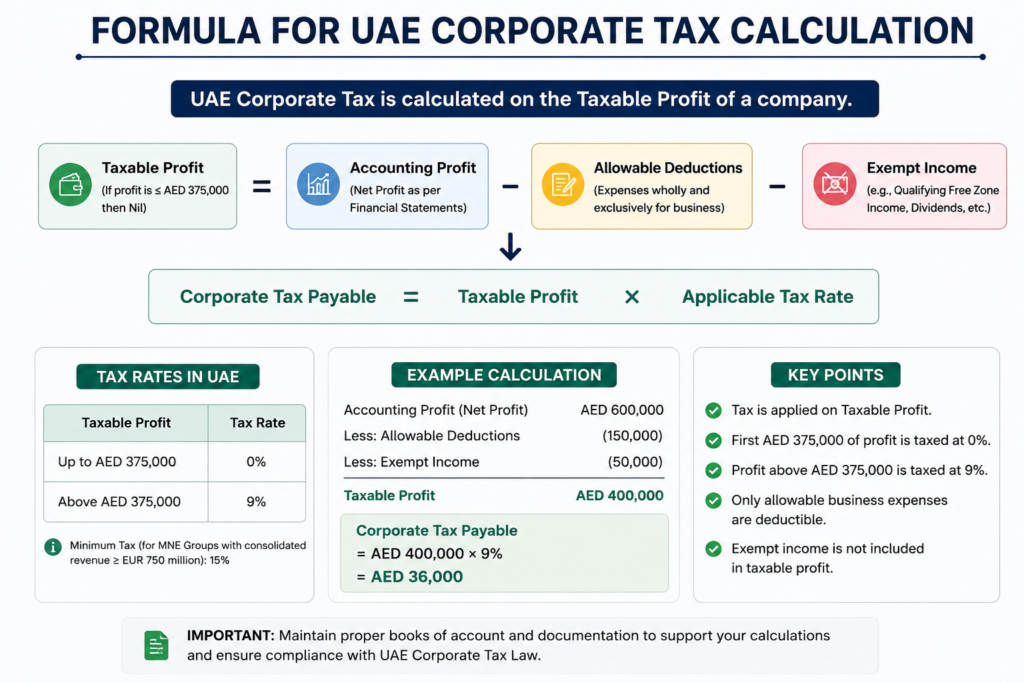
The basic formula is:
Corporate Tax = Taxable Income × Applicable Tax Rate
Businesses should first determine their taxable income before applying the appropriate tax rate.
Example 1
Annual Taxable Income: AED 300,000
Since the taxable income is below AED 375,000:
Corporate Tax = AED 0
Example 2
Annual Taxable Income: AED 700,000
Taxable amount above threshold:
AED 700,000 – AED 375,000 = AED 325,000
Corporate Tax:
AED 325,000 × 9% = AED 29,250
This simple method forms the basis of UAE corporate tax calculation.
Step-by-Step UAE Corporate Tax Calculation
Step 1: Calculate Total Revenue
Add all income generated during the financial year.
Step 2: Calculate Business Expenses
Determine allowable expenses incurred during operations.
Step 3: Determine Accounting Profit
Accounting Profit = Revenue – Expenses
Step 4: Apply Tax Adjustments
Adjust profits according to corporate tax regulations.
Step 5: Calculate Taxable Income
The adjusted amount becomes taxable income.
Step 6: Apply Corporate Tax Rate
Apply 0% or 9% based on the taxable income level.
Step 7: Prepare Corporate Tax Return
File the corporate tax return with the Federal Tax Authority.
Following these steps ensures accurate UAE corporate tax calculation and compliance.
Example of UAE Corporate Tax Calculation
Table 2: Corporate Tax Calculation Example
| Particulars | Amount (AED) |
| Annual Revenue | 2,000,000 |
| Allowable Expenses | 1,200,000 |
| Net Profit | 800,000 |
| Tax-Free Threshold | 375,000 |
| Taxable Portion | 425,000 |
| Corporate Tax @ 9% | 38,250 |
In this example, the business would pay AED 38,250 in corporate tax.
Why Accurate Corporate Tax Calculation Matters
Accurate UAE corporate tax calculation provides several benefits:
Compliance with UAE Laws
Proper calculations help businesses meet FTA requirements and avoid penalties.
Better Financial Planning
Knowing tax liabilities helps businesses budget effectively.
Improved Cash Flow Management
Companies can set aside funds for future tax obligations.
Reduced Risk
Accurate calculations reduce the likelihood of tax disputes and assessments.
Enhanced Business Decision-Making
Management can make informed decisions using reliable financial information.
Corporate Tax Registration Requirements
Businesses subject to corporate tax must register with the Federal Tax Authority.
Required information may include:
- Trade License
- Company details
- Contact information
- Authorized signatory details
- Financial information
Timely registration is important for compliance.
Common Mistakes in UAE Corporate Tax Calculation
Many businesses make mistakes when calculating corporate tax.
Incorrect Revenue Reporting
Failing to report all income can lead to penalties.
Missing Deductions
Businesses may overlook allowable expenses that reduce taxable income.
Poor Record Keeping
Incomplete records can make calculations inaccurate.
Ignoring Tax Adjustments
Taxable profit differs from accounting profit in many cases.
Late Filing
Late submissions may result in penalties and compliance issues.
Avoiding these mistakes improves the accuracy of UAE corporate tax calculations.
Record Keeping Requirements
Businesses should maintain detailed records to support corporate tax compliance.
Important records include:
- Invoices
- Financial statements
- Contracts
- Payroll records
- VAT records
- Bank statements
Good recordkeeping makes UAE corporate tax calculation easier and more reliable.
Free Zone Companies and Corporate Tax
Certain free zone businesses may qualify for corporate tax benefits if they meet specific requirements.
Conditions generally include:
- Maintaining adequate substance
- Earning qualifying income
- Complying with transfer pricing regulations
- Maintaining audited financial statements
Professional guidance is recommended to determine eligibility.
Benefits of Professional Tax Support
Many businesses choose professional advisors to manage corporate tax obligations.
Benefits include:
- Accurate tax calculations
- Regulatory compliance
- Risk reduction
- Professional guidance
- Time savings
Tax professionals help businesses navigate complex corporate tax requirements effectively.
Future of Corporate Tax in the UAE
The UAE continues to strengthen its tax framework in line with global standards. Businesses that invest in compliance systems and professional support today will be better prepared for future regulatory developments.
Understanding UAE corporate tax calculation will remain essential for businesses seeking sustainable growth and compliance in the UAE market.
Conclusion
Accurate UAE corporate tax calculation is essential for every business in the UAE. Understanding taxable income, tax rates, deductions, and compliance helps avoid penalties and ensures financial stability.
If you need expert support for corporate tax registration, tax calculation, filing, bookkeeping, VAT compliance, audit, or financial advisory, NAK Auditing is your trusted partner. We provide professional accounting and tax services across the UAE, ensuring accurate calculations and full compliance with UAE regulations so you can focus on growing your business.
FAQS
UAE Corporate Tax is a tax imposed on the taxable profits of businesses operating in the UAE.
The UAE corporate tax rate is 0% on taxable income up to AED 375,000 and 9% on taxable income above AED 375,000.
Corporate tax is calculated by determining taxable income and applying the applicable corporate tax rate.
Most businesses operating in the UAE are required to register for corporate tax with the Federal Tax Authority.
Some free zone companies may qualify for corporate tax benefits if they meet specific regulatory requirements.
Businesses should maintain invoices, contracts, accounting records, payroll documents, and financial statements.
Social Profiles